Posts

Showing posts with the label conscription numbers

Descriptive Numbers in Prague

Image
Buildings in Prague have two numbers: a descriptive number (číslo popisné) and a reference number (číslo orientační). The descriptive number is unique within one cadastral area. Today these numbers can be found on red plaques, but the original numbers were either painted or engraved onto the buildings or etched onto the front door windows (as is the case with conscription numbers in places like Lviv and Vienna ). In the nineteenth century, Prague’s buildings were given new orientation numbers, which are arranged sequentially within the street or square and are meant to help one find a particular house on a street. Today these numbers are found on blue plaques. “The first descriptive numbering was ordered by Maria Theresa in 1770 and implemented in 1770–1771. The series was given successively as the soldiers went through the settlement describing houses with numbers. Thereafter, every new house was allocated the next number sequentially, irrespective of its location. Mo...

Prewar German-Czech Street Signs in Prague

Image
These bilingual German and Czech street signs (some include descriptive house numbers) date from before WWI, likely before 1892 when the Czech-controlled City Hall decided to replace the city's bilingual street signs with exclusively Czech ones. 

Traces of Prewar Uzhhorod

Image
I recently visited Uzhhorod to see the blooming sakuras. Along with the beautiful sakuras I came across quite a few remnants of Uzhhorod's prewar past. I have two previous posts ( ghost signs  and more ) about Uzhhorod, so t o repeat what I wrote before,  Uzhhorod  (Ungvár  /  Užhorod  /  Ungwar) , a city in Transcarpathia (Zakarpattia Oblast of Ukraine), which is near the borders of Slovakia and Hungary, has a multicultural history. For a long time the region around Uzhhorod was part of the Kingdom of Hungary, later the Austro-Hungarian Empire. After WWI, it was annexed to Czechoslovakia. In 1938, Uzhhorod was transferred to Hungary, and in 1945 it was annexed by the Soviet Union. After the breakup of the Soviet Union, the city became a regional capital in Ukraine. Manhole Covers K Blahut "tűzcsap" means hydrant in Hungarian Demeter Ungvar Demeter Zoltan Uzhorod Fire Hydrants I came across quite a few of these around the c...

Interior Conscription Number in Lviv

Image
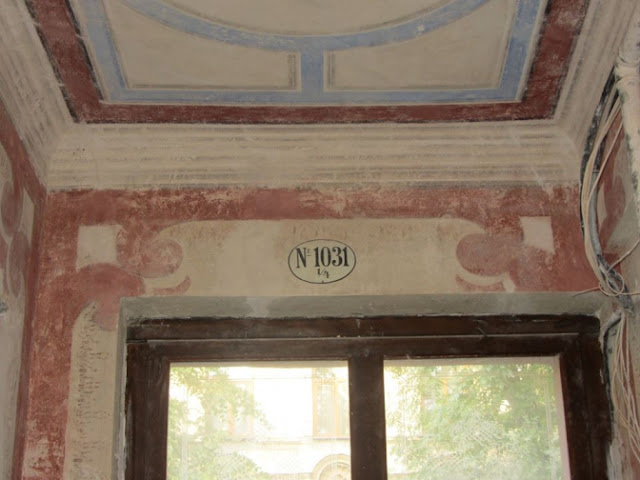
It seems these days there is quite a lot of renovation work being done in Lviv's building. On the one hand, this can pose a risk to remnants of the past, which in the process may be lost, painted over, or removed  —  but on the other hand, this can mean remnants are better preserved or even uncovered. During recent renovation work in the entrance way of a building in Lviv's center old murals from the end of the nineteenth century were found under a layer paint. In the photos that were published there is also an old conscription number (however, not sure of it was uncovered during the work or whether it had always been visible). But in any case, this is the first example of an interior conscription number that I've seen in Lviv . I saw many such examples in Vienna , and one example in Przemysl . Conscription number 1031, from District I (Halytska) Source:    http://lviv.vgorode.ua/

Remnants of the Past in Linz

Image
Boot Scrapers Conscriptions Numbers Guard Stones Various