Posts

Showing posts with the label Poland

Warszawska Orkiestra Sentymentalna: Reawakening Polish Prewar Urban Music

Image
Late last year I had the opportunity to immerse myself in the atmosphere of Lviv's interwar music scene at a live performance of a young band from Warsaw, which plays famous tunes from Poland's 1920-1930s musical heritage. Warszawska Orkiestra Sentymentalna (Warsaw Sentimental Orchestra) comprises a group of young musicians united by their passion for urban folklore. They play familiar and forgotten dance melodies as well as more sentimental tunes for singing and listening. Their repertoir includes songs from prewar theaters, courtyard ballads and couplets from interwar Warsaw and Lviv. The also play compositions by modern artists inspired by urban folklore and traditional Polish melodies, and enliven dance parties with their lively polkas and foxtrots, sultry tangos, and romantic waltzes. The orchestra reaches to the roots of the Polish prewar music scene and continues the tradition of revue performaces, maintaining the timeless charm of these songs while adding their o...

Warsaw Village Band: Preserving the Folk Music Culture of Poland

Image
"Presenting six young people who have created their own version of Polish folk punk! This band has found a welcome in the homes of elderly village musicians who see their traditions disappearing before the onslaught of urban life. They have taken these youngsters under their wing and have taught them the ancient repertoire. The band describes "Cranes" as "an anarchistic protest song; a classic example of defiance and disobedience and a lesson for contemporary societies...Go back home children and be nobody's servants."" from Link TV . "In other moments, the Warsaw Village Band finds comic contemporary possibilities in older tunes. The liner notes to People's Spring describe "Who Is Getting Married" as "a feminist composition, an example of contemporary ideas on emancipation, which apparently existed in the former Polish countryside. "The song's female protagonist sings a tale of not wanting to be married,...

Orkiestra św. Mikołaja: 'From the High Field'

Image
"Z wysokiego pola" (From the High Field) is one of my favorite songs by Orkiestra św. Mikołaja.  The melody of the song is Hungarian,  while the text is a Polish ballad from the region near  Zamość —   an ancestral land.  In the early nineteenth century my great 4x grandfather had an estate in Zalesie. His son, my great 3x grandfather was born in 1822  Łabunie,  the nearby village. Even before I found the connection between the song and my ancestral land, I was always very moved by the song. Something about the melody and lyrics really struck me. The lyrics in Polish and English are below. I also like the image used in the video  —   women in folk costumes against the background of brick ruins. Z WYSOKIEGO POLA Z wysokiego pola, z rajskiego podwórza Zakochał się Jasio w Maniusi jak róża. Gdy się Mani matka o tym dowiedziała, Poszła do murarzy, murować kazała. Murarze, murar...

More Traces of Przemysl's Prewar Past

Image
To continue my last post on Przemysl... Here's a new  ghost sign ! as well as some more manhole covers an old fence with the manufacturer's name and boot scrapers!

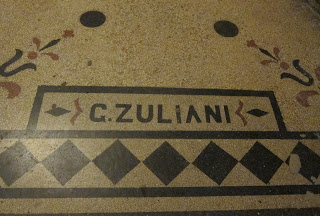
Terrazzo Entrance Ways: Zuliani

Image
This terrazzo floor was made by Giovanni Zuliani’s company (founded in 1892,  Lviv).  Two examples in Lviv: G. Zuliani and Son It seems this company also installed floors in  Krakow and/or had a branch there. This example I found in the entranceway to the hostel where I stayed in Krakow:

Prewar Relics in Przemysl

Image
Various traces of Przemysl's prewar past Boot Scrapers indoors with handle (missing part) also with missing part

Benchmark in Przemysl

Image
I found an old benchmark in Przemysl, located on a little post near the river. The outer ring reads "Znak Wysokosci" (Height Marker), followed by 2 letters and 4 numbers, looks like AA-0001, which means it was probably the first one in the series from this period (1947-1955). The inner ring reads "Uszkodzenie Podlega Karze" (Damage Is Punishable)

Conscription Numbers and Street Signs in Przemysl

Image
I found some more interesting information about conscriptions numbers  since I wrote my first post on them. From John D. Pihach's "Ukrainian Genealogy": "House numbers, also called house conscription numbers, had their origins with the Austrian imperial regime's need to know the names of all eligible men who could be drafted into the army when the need arose. A metal plaque with a number was attached to each house. With this number in the records of births, military officials could examine the transcripts in the bishop's office and calculate the age of everyone in a particular house." It is not uncommon in Przemysl to find two, three, or even four different number signs on one building (dating to different periods and regimes: Austrian, interwar Polish, Communist, modern). The reason is probably because unlike in Lviv, in Poland there was never a campaign to remove Polish inscriptions from the urban landscape. Thus old signs were generally kept, ...

Prewar Manhole Covers in Przemysl

Image
In Poland it's a little more difficult to determine the age of manhole covers than in Ukraine, because in Ukraine if it's in Polish, it's old; but in Poland, everything is in Polish... However, by comparing them with prewar ones in Lviv, I think I've been able to distinguish which ones are old. Przemysl has several manhole covers produced by the Wisniewski Brothers factory. Fabryka Maszyn Odlewnia Żelaza i Metali Bracia Wiśniewscy  w Przemy ś lu Machine Factory Iron and Metal Foundry Wisniewski Brothers in Przemysl  A business directory from Przemysl 1938 lists the  Wiśniewscy  brothers' hardware store : Below is a cover made by just one of the Wisniewski brothers. Pomiar Miasta means “measurement of the city” Water valve covers made by Roman Sapa & Son in Tarnów This zasuwa (stop valve) cover is exactly like ones in Lviv   — a testament to the fact that Lviv and Przemysl were once in the same s...

Large Ghost Sign in Przemysl

Image
An ad for PKO ( Poland ’s largest bank) bankbooks, likely from the 1970s.

Hand-Painted Sign in Lublin

Image
At first I thought this was a ghost sign, but after looking closer at what it says and later finding that there really is a store with that name now, I understood it was not. It's a store that sells gifts, souvenirs, and postcards. I really like the sign nevertheless.

Lublin's Guard Stones

Image