Posts

Showing posts with the label Riga

Anchor Plates in Riga

Image
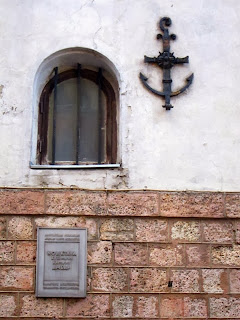
A sampling of anchor plates from Riga. I especially like the ones shaped like anchors.

Reusing Old Cannon in Riga: My Attempt to Solve a Mystery

Image
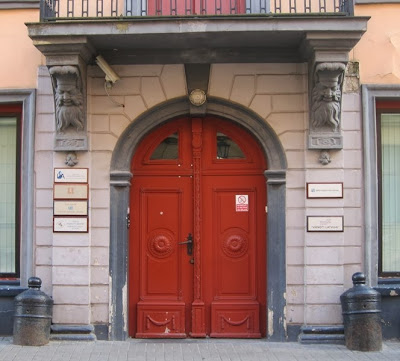
At first I thought these were guard stones, but then I realized their placement is not very typical for guard stones, which were placed at the corners of entranceways to protect the corners of the buildings from the wheels of carriages. Later I was told they are actually old cannon , but their purpose is still not clear. According to Wikipedia, in the 17th and 18th centuries “old cannon were often used as bollards on quaysides: they would be buried in the ground muzzle-first to approximately half or two-thirds of their length, leaving the breech (rear end) projecting above the ground for the attachment of ropes. ” These obviously are not located on a quayside, but reading this made me come back to another idea I had: that the cannons with the knobs were used as hitching posts. (Of course boat ropes and horse reins differ greatly, but whereas the boat ropes would have been tied around the whole cannon, my guess is that the horse reins could have been tied to the small knob on ...
Guard Stones in Riga

Image

Swedish Manhole Cover in Riga

Image
In Riga I found a manhole cover dating from 1901 . Upon researching it later, I realized it was made by the Swedish company called  Stockholms Allmänna Telefonaktiebolag Sweden ’ s first telecom operating company (founded in 1883), Stockholms Allmänna Telefonaktiebolaget (Stockholm General Telephone Company) (SAT) installed and operated telephone equipment. The company had a long-term partnership with LM Ericsson & Co., finally merging with the company in 1918. image from History of Ericsson I was curious why a Swedish-made manhole cover would have been installed in Riga in 1901, as Latvia was then under Russian rule. But I read that at that time the company Ericsson had many contacts with Russia , and in the late 1800s was delivering telephone exchanges to Russia . The first telephone exchange was installed in Kyiv in 1893 and was followed by Kharkiv (1896), Rostov (1897), and Riga , Kazan and Tbilisi (1900).

Ghost Signs in Riga

Image
Ģipša Fabrika (Gypsym Factory) is located on the island of Kipsala, a former fishermen’s village. This 19th century brick building used to be a plaster factory. Now it is part of a luxury apartment complex.   Somewhere in the Old Town These two signs are on a building on Albert Street, a street famous for its Art Nouveu buildings My best guess is that this says “tapezierer,” which seems to be a German word meaning upholsterer, decorator, or paperhanger. Seems to say something like “un Deguretais,” whatever that could mean... 

Remnants of Merchants' Hoists in Riga

Image
Although not nearly to the same extent as in Tallinn, remnants of the merchants' hoisting mechanisms remain on several of the medieval houses in Riga.                                                                                   a granary from the 18th century