Posts

Showing posts with the label diaspora

Говірник: Шляк трафив

Image
From a series of videos about the origins and meanings of various Galician words and phrases

Galician Culinary Dictionary

Image
To supplement my "diaspora" dictionary, here's a list of Galician culinary terms. Some I have on my list , but here are many more. ГАЛИЦЬКИЙ КУЛІНАРНИЙ СЛОВНИК -А- Аєрконьяк – яєчний лікер Андрути – перекладений вафельний торт, вафлі. Аниж – аніс Арак – алкоголь Афини – чорниці -Б- Баняк – горщик, казанок. Бараболя, бульба – картопля. Бараболянка, бульбянка – кишка, начинена тертою сирою бараболею, з шкварками. Спочатку підварюється а потім смажиться чи запікається. Біґос, бігус – тушкована капуста. Готується з квасної і свіжої капусти, з м’ясом та вуджениною (див. вудженина) Бібкове (бабкове) листя – лаврове листя Бішкопти – бісквіти. Часто вживається в значення бісквітного печива, а не бісквітних коржів до торту. Бритванка – форма для запікання, переважно прямокутна або квадратова Будин, будинь – пудинг Брайтрура, байтура – духовка -В- Вуджений, вудженина – копчений Виделець – виделка Вепровина, вепрове м’ясо – свинина Воловина – яловиче м’ясо Вушка – маленькі вар...

Galician Culinary Vocabulary

Image
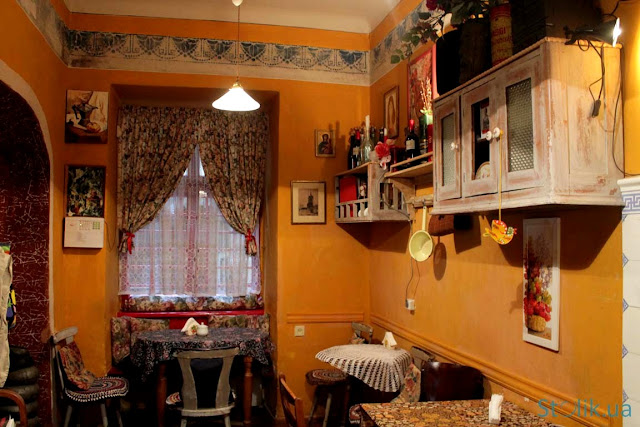
Recently on Facebook, "Пані Стефа" shared a post about Galician cuisine using Galician culinary vocabulary. I'm familiar with many but not all words. Original post found here . Image from the cafe Spizharka (Galician word for "pantry") in Lviv Баняк, ринка, миска і тареля в креденсі.  Зупа з ляним тістом і росіл з клюсками, налиті кохлею в таріль.  Салатка в салятерці.  Мізерія і зеленець. Карманадлі і шницлі, засмажені на пательні.  Парені, накипляки і будині. Яськи, шпарагівка, каляфйори, шпараґи, селєра, пора і калярепа. Риж, грисік, кулеша, логаза і пенцак. Пляцки, цвібак, андрути, мармоляди, конфітури і галярети в спіжарці. Птисі і бішкопти. Ґоґодзи, гечі-печі, фіги, дактилі і міґдали. Морелі, трускавки, морви, піґви, цитрини і помаранчі. Цинамон, паприка, коляндра і бібкове листя. Кава з чоколядою в філіжанці. Келішок і канапка. The book Felix Austria by Sofia Andrukhovych, set at the turn of the 19th and 20th ...

Soccer Terms in Interwar Galicia

Image
Recently, Gazeta.ua published an article (in Ukrainian) about soccer in interwar Galicia, and it includes a list of soccer terms used in Galicia in that period. In the diaspora we still call soccer (football) копаний м'яч (literally, "kicked ball"), the term that was used in pre-WWII Galicia. Today in Ukraine, the term "футбол" (football) is used. Photo: 1942, Ivano-Frankivska Oblast. Source: ”Локальна історія”/localhistory.org.ua Футбольні терміни, що використовували на Галичині у міжвоєнні роки: відсторона – офсайд воковер – неявка дефензива – захист грач – гравець грище – футбольне поле дружина – команда займак – штрафний удар змагун – гравець карний мет – пенальті копун – футболіст наріжняк – кутовий удар офензива – напад реміс – нічия

The Ukrainian Alphabet and the Soft Sign

Image
There are several differences in the Ukrainian alphabets used in the diaspora and in Ukraine, in particular, what we call the alphabet, the way we pronounce the letters, the melody we use when singing the alphabet (or the lack there of a song), as well as the difference I only recently discovered - the placement of the soft sign. In Ukraine the soft sign "ь" doesn't come at the end of the alphabet as I learned, but third to last. It was quite a big shock for me to discover. However, this was a relatively recent change. In 1990, the soft sign was moved from the end of the alphabet to the place after the letter "щ" as it is in the Russian alphabet. I'm surprised it wasn't moved back a year later when Ukraine gained its independence. First of all, we usually say "азбука" or "абетка" while in Ukraine it is more common to say "aлфавіт" or "абетка" (for children). When we (at least my Chicago diaspora community) sing...

The Lexicon of the 3rd Wave Ukrainian Diaspora

Image
Please go to my new website Forgotten Galica to read this post. Click here . I've already published two posts about the vocabulary of the third-wave Ukrainian diaspora (found here and here ), but now I've combined both lists, added new words, fixed some mistakes, and as a result I have a comprehensive list with over 500 words: CLICK HERE FOR FULL LIST , which I made on Google Spreadsheets. For many words, I've also included the Polish and Russian translations, as well as a comment on the meaning or usage. Before I get into the specifics of the list, I wanted to write a few words about the goal of this list and my usage of the words "archaic" and "diaspora." Above all, this list is a way for me to document the way my family in the United States spoke and speaks. Living in Ukraine, I've picked up the local language and am beginning to forget some of the words that I heard and used growing up. Thus I've made this as a resource for myself. Howe...

Ukrainian Songs in the Third Wave Diaspora Community

Image
In the diaspora I grew up singing certain Ukrainian folk songs, which I thought every Ukrainian in Ukraine knew, so I was surprised to find out that it wasn't true. I grew up in a community made mostly of descendants of Galician immigrants and was a member of the scouting organization Plast  —  two facts which largely influenced the musical culture I was exposed to. Many of the popular songs in this diaspora community are Galician, Hutsul, and especially Lemko, as well as kozak, Sichovi Striltsi, UPA, and Plast songs, and of course songs composed by Volodymyr Ivasiuk (which are just as popular in Ukraine as in the diaspora). Some of the songs we sing seem to have been somewhat forgotten in Ukraine for one reason or another  —  maybe partly because we were more free to sing our folk and patriotic songs in the diaspora than Ukrainians were under the Soviet Union. Many of these songs were popularized by the Ukrainian-American singer Kvitka Cisyk, herself a member o...

The Vanishing Galician Accent and How it Lingers in the Diaspora

Image
Please go to my new website Forgotten Galicia to read this post. Click here . The vocabulary (which I wrote about here  and more recently here ) and accent of the diaspora community in North America (specifically the community that descended from the third wave of immigration (1940s-50s), many of which came from Galicia) differs somewhat from the vocabulary and accent heard today in western Ukraine. In the diaspora this vocabulary and accent remained rather stagnant while in Ukraine due to various factors (such as Russification and just due to the natural evolution of languages), the language, both its vocabulary and the sound, has changed. Thus the language spoken in Galicia before WWII has been better preserved in the diaspora than it has in Ukraine (in western Ukraine it can be heard only a little in rural areas/from the oldest generation.) The Ukrainian Historical and Educational Center of New Jersey has on its website historical audio recordings where the early 20th c...