Posts

Showing posts with the label Tallinn

Neck Ring in Tallinn

Image
This neck ring is attached to a pillar of the Town Hall in Tallinn. It was used to punish people for small crimes.

Defense Rings in Tallinn

Image
At first I thought these were hitching rings, but my friend in Tallinn explained that they were in fact used as part of the defense system of the Old Town. Some sort of rope or chain would have been tied from one ring to another one attached to the building across the road to stop invaders from passing, especially effective when invaders were on horseback.

Hitching Rings in Tallinn

Image
I think these are hitching rings near a medieval door in Tallinn's old town.

Anchor Plates in Tallinn

Image
A sampling of anchor plates in Tallinn.

Guard Stones in Tallinn

Image

Vault Lights in Tallinn

Image
I found a few vault lights in Tallinn made by а Russian company before the Russian Revolution. The inscription says : “ С.-Петербургское с текольно-промышленное акц . о-во” The St. Petersburg Glass Work Manufacturing Company (Санкт-Петербургское стекольно-промышленное акціонерное общество) existed between 1911 and 1918, but as St. Petersburg was renamed Petrograd in 1914, it means that these can be dated from 1911-1914, making them 100 years old.

Pre-Russian Revolution Roller Shutter in Tallinn

Image
In Tallinn , I found an old metal roller shutter with a Russian inscription. Estonia was part of the Russian Empire until 1917 and so the shutter dates to before the Russian Revolution. Тильманское Железоделательное Акц i онерное (анонимн.) Общество. Прушковъ. From an issue of the newspaper Сибирскій листокъ , dated April 10, 1905, there is an advertisement for Штори ( draperies) made by the company ,, Тильманское Желѣзодѣлательное Акц i онерное (анонимное) Общество ” въ Прушковъ , which means Tilman Ironworks Joint Stock Company in Pruszków . Pruszków is a town outside of Warsaw. This part of Poland was also under the Russian Empire at that time. Note: the Russian orthography used on the shutter and in the newspaper is from before the last major Reform in Russian spelling (1917), as can be seen with the use of the letters і ,  ѣ , ъ .

150-Year-Old Iron Gate in Tallinn

Image
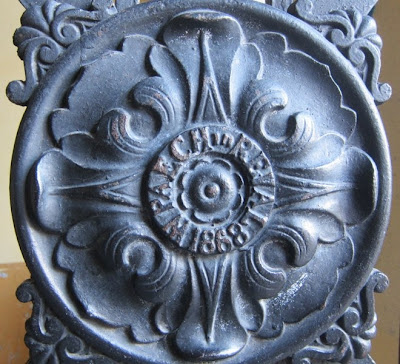
An old iron gate in Tallinn. The inscription says "W. Paech in Reval 1868." Reval was the old name for Tallinn, in use from the 13th century until 1917.  Estonia was part of the Russian Empire in the 19th century; however, Baltic Germans made up the majority of the city's residents (and made up most of the upper and higher middle classes), so it's not surprising to see German in Tallinn.

Ghost Signs in Tallinn

Image
This ghost sign I saw through the window of my hostel room. It is on an former furniture factory in a courtyard. The sign says “Mööblitööstus,” which is Estonian for “furniture manufacture.”     Two restored hand-painted signs from when this building used to house a pharmacy and a gallery. Now it is a consulate of the Russian Embassy.

The Ukrainian Cultural Center in Tallinn: Preserving Vanishing Arts and Crafts

Image
One of the highlights of my trip to Tallinn was my unexpected tour of the Ukrainian church and Ukrainian Cultural Center . The cultural center is located in a beautiful 14th  c entury building located within the medieval walls of Tallinn ’s Old Town . The center includes a museum, which was created “ t o help preserve disappearing cultures. ” The  museum  showcases Ukrainian arts and crafts, as well as exhibits from  Estonia, Russia, and the United States. The Grusbeke Tower , located about 25 meters from the center, now belongs to the center and has a collection of hand-made mechanical toys, as well as two wooden looms that are still used.   A n integral part of the Ukrain ia n Cultural Center is the Labora Workshops . M edieval arts and crafts   are taught and made with help of tools from the 19th and early 20th centuries . The center also promotes Ukrainian culture by offering workshops in making Ukrainian crafts. ...

Remnants of Merchants’ Hoists in Tallinn

Image
Tallinn ’s Old Town used to be an important trading city on the coast of the Baltic Sea . Fortunately, a majority of the medieval buildings have survived, including many of the merchants’ houses. The attic spaces—and sometimes several of the upper floors—of these houses were used to store the merchants’ goods. The merchandise was hoisted to the storage areas with ropes, which were wound by winches. The storage levels had special portals for the goods to enter. Wooden beams were attached to the buildings above the openings to guide the rope. Quite a few of these protruding beams and portals remain in the city. Some of the beams have ropes and hooks, but these are probably more recent. diagram of the inside of a house with winch, protruding beam, and portals Now a restaurant called Peppersack. Shows how the merchandise may have looked when it was being hoisted. here three floors were used for storage, as one can see from the portals   ...