Posts

Showing posts with the label ancestors

'Krajka. W domu': Forgotten Music from Polish-Ukrainian Borderland
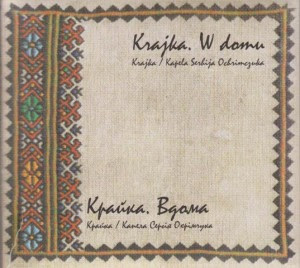
Image
A folk band from Przemysl  —  Krajka, together with Ukrainian musicians  —  released a new album dedicated to the lands that lie along the current Polish-Ukrainian border. "The album contains traditional music from the Polish-Ukrainian borderland, from the regions of Kholm, Lubaczow, Przemysl, to the Carpathian mountains and valleys. These lands were once replete with the splendor and richness of culture, traditions, and ethnos. Today this music is largely unknown and forgotten. It has been reconstructed using recordings gathered during field expeditions and from available materials  —  to save it from oblivion and bring back its ancient luster." "The album 'Krajka. W domu' contains songs exclusively from the Polish-Ukrainian borderland. This territory, on which from time immemorial reigned a balance of diverse cultural components, was brutally destroyed by the war and postwar deportations. The expulsion of Ukrainians, Boykos, and Lemkos is above ...

Sangre de Muerdago: Interpreting Melodies Once Lost and Found Again

Image
The Galician (Spain) folk band Sangre de Muerdago released a new EP "Os Segredos da Raposa Vermella"  (The Secrets of the Red Fox) "Before humans started building with concrete and steel, much earlier before machines reigned, and the steam locomotive was invented. There was a little red fox that wandered through the woods of the Iberian northwest, in a land where its people were  known as the Galaicos. This red fox liked to listen to the melodies of the leaves and the stones, to the songs of the streams and flowers, and she sung and sung and whistled as she wandered through the forests looking for food and adventures. Until one day she knew so many songs, more songs than any other red fox in those woods. Even more songs than the ravens themselves. Afraid of forgetting those beautiful melodies, she decided to start writing a little book with her favourite songs. The book had a cover of moss and paper of birch bark, and on its pages she wrote and drew. Many ...

Holodomor Memories

Image
My paternal grandmother was from central Ukraine, which for centuries was under the Russian Empire, and then from 1922 the Soviet Union. As such, unlike the rest of my ancestors who lived in western Ukraine (under Austria and then Poland), they experienced the Holodomor (Famine-Genocide) in 1932-3, a man-made famine which left millions of people in Soviet Ukraine dead. Five years ago I traveled to Kamianske (until a few months ago Dniprodzerzhynsk) to meet my grandmothers sisters who were still alive. It was a very interesting experience, as it was my first encounter with relatives who were not from Galicia, and thus with relatives who had a different history, language, and culture. They shared with me stories and old photographs of my ancestors. To commemorate the victims of this horrible tragedy, I want to share my family's account of their experience of the Holodomor, for it's these personal stories which should never be forgotten. Below is an excerpt about the Holodomor...

Searching for Traces of the Lipińskis in Oleskiy Region

Image
My great (x5) grandparents Feliks and Tekla Lipiński moved to the village of Koltiv (Kołtów) from Lviv in 1811. Feliks was invited by Count Józef Baworowski to his estate in the countryside to conduct his court orchestra. The former landlords, the Starzeńskis, built a beautiful garden house on a high hill where the court orchestra would often play. Feliks and Tekla's son, the famous violinist and composer Karol Lipiński , often visited them in the village. Nothing of the garden house, the palace, the graves of the noblemen or my relatives, or any other traces of these times remain. Much was destroyed during WWI, and in WWII Koltiv found itself on the front. While Brody is remembered for the "Brody Cauldron" when in 1944 the Red Army encircled Brody and destroyed the German forces, the neighboring region was called the "Koltiv Corridor," due to the fact that the German front in the Koltiv area was shattered by the Soviet army, which broke through a narrow gap i...

Tem Eyos Ki: 'Cruithne'

Image
when it comes the day that I'm spit out what have I learned?  what folklore will I keep?  could it be that I shared thoughts with my progenitors? did as they did, kissed words they've kissed intrinsically chaotic dependent attracted, suspended to understand to allow the stories to sink deep when it comes the day that I'm spit out what have I learned?  what folklore will I keep?  could it be that I shared thoughts with my progenitors?  did as they did, kissed words they've kissed cruithne cruithne cruithne  could it be cruithne... <a href="http://harlanrecords.bandcamp.com/album/tem-eyos-ki-lp-remixed-remastered">Tem Eyos Ki-- LP (remixed/remastered) by Tem Eyos Ki</a> scarred warrior throats long winded legends familial lines  faces etched in skies co-orbital motion forced thousands of years  listening, they're listening, i'm listening listening, th...

'The Lost: The Search for Six of Six Million'

Image
I recently finished reading Daniel Mendelsohn's book  The Lost: The Search for Six of Six Million about his search for what happened to six of his relatives during the Holocaust. He searched specifically for the fates of relatives who lived in Bolekhiv, Ukraine, a place where his Jewish ancestors settled many centuries ago. His research took him all over the world, visiting places where the tragic events happened and meeting survivors who he hoped would be able to share with him specific details about these relatives and what happened to them. It was a very well written and engaging story, both his own journey and search, but also the story of his relatives. I highly recommend this memoir as a good source from which to learn what exactly happened to the Jews of one particular town in Galicia. It's these personal stories that really touch you, the people become no longer just part of a statistic of all the people who perished during the war, but people you feel you knew. Duri...

Memoirs of Life in Prewar Galicia, WWII, and Gulag Camp: Ukrainian Version

Image
During WWII my grandmother was separated from her sister, only to be reunited with her half a century later on the other side of the world. While my grandmother and her family succeeded in escaping Ukraine before the Soviets took over their homeland in Galicia, her sister Maria had an entirely different fate, which carried her into the underground movement, a Gulag work camp, and exile in Siberia before she was able to return to Ukraine. By the time I was old enough to be curious about my grandmother's life in Ukraine and experiences during the war, it was too late to ask her. Fortunately, her sister took up the daunting and I'm sure emotionally difficult task of reliving her tumultuous life in order to document her experiences for her descendants. It was through these memoirs that was I was able to learn about my grandmother's life and her family, about the country I had heard so much about, about their struggle and sacrifices for a land they loved so dearly. Although ...

On Makhno's Wife Halyna Kuzmenko

Image
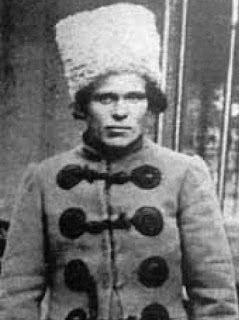
Nestor Makhno (1888-1934) was a Ukrainian anarcho-communist revolutionary and the commander of an independent anarchist army in Ukraine during the Russian Civil War of 1917-1922. Nestor Makhno's last wife was a teacher from Huliaypole, Halyna Kuzmenko. They were married in 1919. Together they crossed the Romanian border, escaping the Bolsheviks. They divorced in the 1920s. During WWII, after the Germans occupied Paris, Halyna and her daughter went to Germany, where in 1945 they were arrested by the NKVD. Halyna received a sentence of 10 years in the work camps. She was imprisoned in Mordovia, in Dubrovlag.  In my great aunt’s memoirs she writes about her time in a camp in Mordovia, and comments on her encounter with Halyna Kuzmenko: "They brought arrested women from all over. Often among them would be interesting people: to our camp, we were told, came the wife of Nestor Makhno, who had been arrested in Berlin. She was an old, tiny, gray-haired woman who wore glas...

Ivan Franko: On His Visits to My Family's Library and His Phenomenal Memory

Image
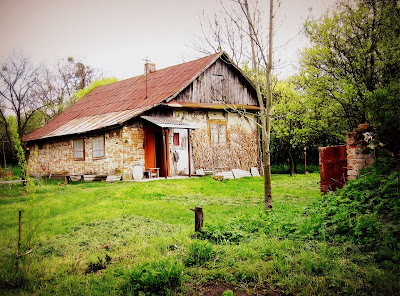
My great grandmother had the honor of meeting Ivan Franko, who used to visit her aunt and uncle's library in the village of Tsishky, near Oleskyi Zamok. Her aunt and uncle were Toma Dutkevych, the parish priest and one of the founders of the agricultural organization Silskyi Hospodar, and his wife Julia Kuhn. This was in the early 1900s. This is what is left of the Duktevych's house. It used to be several times larger. Below is an excerpt from my great aunt's memoirs, in which she describes her mother's memories and impressions of Ivan Franko. ***** "In Tsishky the Dutkevyches had a large library. Years before, when he had come to visit them, the renowned Ukrainian poet and social activist Ivan Franko often made use of this library. My mother, a 17-year-old girl at the time, eagerly listened to her elders' conversations and admired Ivan Franko's phenomenal memory. After spending even a short time in their library, Franko would then in c...

Olena Kulchytska: Combining Galician Secession and Ukrainian Folk Art

Image
Olena Kulchytska was a Galician Modernist, legendary Lvivian, famous artist, and skilled teacher. She is my favorite Ukrainian artist; in particular, I like how she combines Secession and Ukrainian folk art. Furthermore, she lived about 5 minutes away from where I live in Lviv, and in the interwar period in Peremyshl she taught my grandmother drawing at the Ukrainian gymnasium for girls. "Olena Kulchytska was born on September 15, 1877, in Berezhany, in Ternopil region to the family of a Galician lawyer Lev Kulchytsky and Maria Stebelska. The artist’s parents were descendants of old Ukrainian families which preserved, apart from family coats of arms, the spirit of Ukrainianness and honorable attitude to their land. Olena, her sister Olha, and brother Volodymyr spent their childhood in small district towns of Galicia – Lopatyn, Kamianets-Strumyliv (now Kamianka Buzka), Horodok – in a special atmosphere of customs and traditions which reigned in the milieu of Ukrainian intellig...

Josyfa Kühn 2x

Image
In the eighteenth century in/near Lviv there lived a a nun and poet named Josyfa Kühn. The following century in Brody, Galicia, there lived a woman named Josyfa Kühn, the daughter of a German merchant (picture of her can be found in this article ). The latter was my great-great grandmother. While the only connection between these two women is their name, I nevertheless feel a connection to the nun, who is famous for a series of poems she wrote about the outskirts of Lviv (written in German). Furthermore, she is known in Ukrainian pop culture due to the poem about her written by contemporary Ukrainian writer Yuriy Andrukhovych and the song using this text by the rock group Mertvyi Piven. Unfortunately, I haven't been able to find an online version of the song, but here's the poem: Йосифа Кун. Дух Дозволь мені кружляти над тобою. Я знав Йосифу Кун, я знав ще кількох жінок. Песій Ринок вітав мене песім гавкотом, А черниці з вулиці Сакраменток Ховалися в ніша...

My Ancestor Karol Lipiński: Violinist and Conductor in Lviv's First Theater

Image
Lviv has always felt like my native town; however, in recent times none of my ancestors were from here. But in the last few years I discovered that my direct ancestors on two sides of my family (Polish and Austrian) did live in Lviv, but over 200 years ago, in the early 1800s. The Lipińskis My great-great-great-great-great grandfather was Feliks Lipiński. "Born in 1765 in Zakliczyn near Tarnow, his life had presumably followed a course similar to that of other talented peasant children. He may have been educated in music in one of the numerous monasteries and then probably took up a teaching career at aristocratic courts where he tutored his charges in playing several instruments." "The end of the 18th century saw Feliks Lipinski in the estate of the Potocki family at Radzyn near Lublin. His first born was the son Karol Jozef who came into the world on 30 October 1790." Potocki Palace (built 1750-1759) in Radzyn, Poland Karol Lipinski It was this s...

Boyko Music: 'At the Foot of the Carpathian Chain'

Image
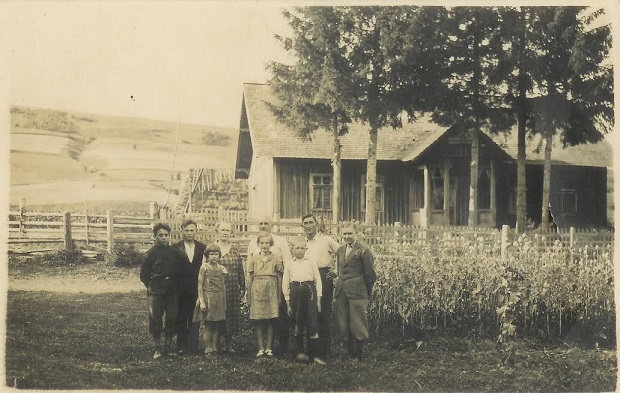
My paternal grandfather was born in the village of Lybokhora (Turka District), the "capital" of Boyko instrumental music. His parents, who were from the Sambir and Lviv regions, moved to this Carpathian village in the early 1900s to direct and teach at the local school. This is a picture from Lybokhora (1930s) of my grandfather (white shirt in second row, with bird on his shoulder) with his parents, siblings, and some family friends.  Many years ago I came across an album of authentic music recordings from his village. When I listen to it, I can image that during celebrations and rituals, my ancestors heard precisely this music. Links with info and downloads: http://lemko.org/lvpro/turka.html http://www.ex.ua/7952774 http://www.discogs.com/

EuroMaidan Anniversary: 'A Line from My Autobiography'

Image
Today marks the second anniversary of the beginning of the Revolution of Dignity, or EuroMaidan, which ended the rule of Yanukovych in Ukraine. I'd like to share a video for a song based on a text by contemporary Ukrainian writer Oksana Zabuzhko called "A Line from My Autobiography." The song is performed by the Telnyuk Sisters, and the video shows images from the revolution: Ukrainians fighting for their freedom, dignity, and land, including the violent battles. The text is basically about how "my ancestors" have always been fighting for their land, which has always belonged to them. And ends with these words: Oh and they were a strong breed — * Solovky, Magadan, Kolyma... My ancestors were a people — A people, which is no longer. * names of Soviet prison camps РЯДОК З АВТОБІОГРАФІЇ Мої предки були не вбогі На пісні та свячені ножі — З моїх предків, хвалити Бога, Заволокам ніхто не служив! Дарували від батька до сина Чест...