Posts

Showing posts with the label mounting blocks

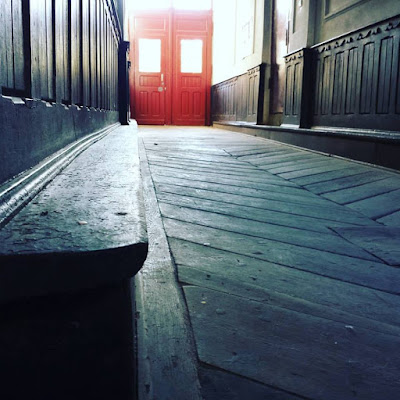
Carriage Curbs in Lviv
Image
In many of Lviv's old buildings there is a carriage entrance way, a driveway which led from the street to the courtyard for carriages to pass through. Along the sides of the entranceway there is an elevated platform, the main purpose of which I believe is to act as a curb, for the carriage not to bump into the walls, holding a similar purpose as the guard stones , which often flank the doorways. Maybe it could have also been used as a carriage step . Most are stone, but I have come across a few wooden ones.

Mounting Blocks in Charleston

Image
In the 18th and 19th centuries, mounting blocks were common in cities, towns, and villages. Usually made of stone, they were installed in key locations, usually near inns, churches, country houses, to aid mounting or dismounting a horse, carriage, stagecoach, etc. The more elabarote mounting blocks are called carriage steps  —  these slabs had steps carved into the stone. Together with hitching posts and guard stones, they were important and functional elements of the horse-drawn transportation infrastructure. My dad was recently in Charleston, SC and took a lot of photos of carriage steps for me:

Kozak Village in the Luhansk Region

Image
I read an interesting article in Ukrainian, in which the author uncovers the original purposes of the layout of an old Kozak village and the design of the houses. Below is my translation of most of it. The link to the original article and a few more photos can be found here . Among the modern mining settlements in the far eastern Ukrainian region of Luhansk, the author of the article found an ancient village called Naholno-Tarasivka. Its official founding date is 1775. “…in place of fences the old streets of the village have solid stone walls, interrupted only by the houses. Houses here were built on the outer part of the plot with façades directly overlooking the street. As such, fences and buildings created a continuous stone wall along the street. “To understand the reason for this and other arrangements, which will be discussed further, let us return to a time when the Ukrainian steppe was an undeveloped Dyke Pole (Wild Fields), on which only a small number of ...