Posts

Reusing Old Cannon in Riga: My Attempt to Solve a Mystery
Image
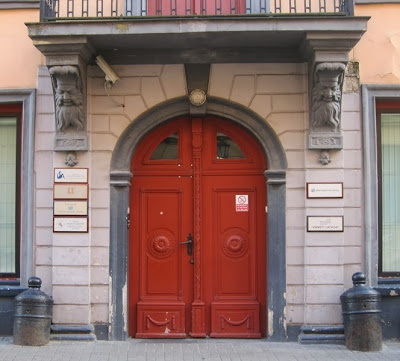
At first I thought these were guard stones, but then I realized their placement is not very typical for guard stones, which were placed at the corners of entranceways to protect the corners of the buildings from the wheels of carriages. Later I was told they are actually old cannon , but their purpose is still not clear. According to Wikipedia, in the 17th and 18th centuries “old cannon were often used as bollards on quaysides: they would be buried in the ground muzzle-first to approximately half or two-thirds of their length, leaving the breech (rear end) projecting above the ground for the attachment of ropes. ” These obviously are not located on a quayside, but reading this made me come back to another idea I had: that the cannons with the knobs were used as hitching posts. (Of course boat ropes and horse reins differ greatly, but whereas the boat ropes would have been tied around the whole cannon, my guess is that the horse reins could have been tied to the small knob on ...

Guard Stones in Riga

Image

Guard Stones in Tallinn

Image

Vault Lights in Tallinn

Image
I found a few vault lights in Tallinn made by а Russian company before the Russian Revolution. The inscription says : “ С.-Петербургское с текольно-промышленное акц . о-во” The St. Petersburg Glass Work Manufacturing Company (Санкт-Петербургское стекольно-промышленное акціонерное общество) existed between 1911 and 1918, but as St. Petersburg was renamed Petrograd in 1914, it means that these can be dated from 1911-1914, making them 100 years old.

Mackenzie & Moncur Vault Light in Edinburgh

Image
Mackenzie & Moncur Ltd, founded around 1850, manufactured and constructed hothouses in Scotland and part of England . They also specialized in the manufacture of pavement lights.  

Haywards Vault Light in Edinburgh

Image
In 1848, Hayward Brothers was established. Their main products were ironwork: ranges, stoves, coal plates, circular and spiral staircases, and ventilators. Shortly after 1857, they started to produce iron pavement lights glazed with rough cast glass. And in 1871 one of the brother’s patents, “Improvements in Pavement Lighting,” brought about a significant improvement to the product. “Before then, lighting basements had been problematic. Open gratings let in light, but were open to the weather as well, and hard to stand and walk on; slab glass in iron frames was better, but admitted only a small amount of useful light; triangular glasses had been tried, but were not well designed, and threw most of the incident light back out again. Edward's idea was to split the triangular light in half: now the rays of light entering the top were throw horizontally into the space below, lighting areas deep inside.” Ad from 1925  Images taken from Glassian

Vault Light in Lviv

Image
I have only come across one of these in Lviv. I had no idea what it was until I saw similar panels in Edinburgh and Tallinn and turned to the Internet for help. It turns out it is a vault light to illuminate the basement. I found a good description on the Glassian website : “Vault Lights, also known as Sidewalk Lights (or Pavement Lights in the UK ), are those old glass prisms set into sidewalks to let light into vaults and basements below. Prisms were used instead of flat glass to disperse the light, diffusing it over a large area; plain flat glass would simply form a bright spot on the floor below, not providing much useful general lighting.  “The idea originated in the 1840s as deck lights. They were used on ships to let light below-decks… The idea caught on; by the late 19th century they were common in the larger downtowns, especially New York . Their use declined as electric light became cheaper and better, and by the 1930s were on their way out. Now, th...