Posts

Showing posts with the label countryside

Benchmarks in England

Image
Across Great Britain is a network of benchmarks.  There used to be about half a million benchmarks, but as they have become obsolete, about half have disappeared.  The first primary leveling in the UK was carried out in 1841-60, the second in 1912-21, and the third in 1951-56. The horizontal bar above the arrow denotes a calcuated and known height or altitude in relation to other Odnance Survey marks across the UK. The datum for mainland Great Britain is mean sea level at Newlyn. They were used for map making before the advent of GPS. This one is on a pillar outside the Corn Exchange building in Leeds These are in Bibury  
Stiles in Bibury

Image
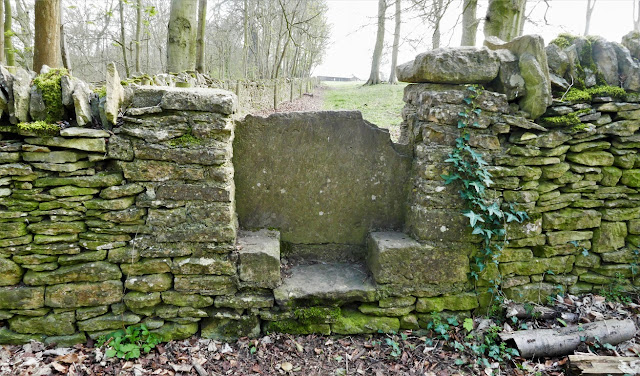
The village of Bibury is located in the Cotswolds  —  a region in south-central England famous for its Cotswold stone (a type of limestone) and historic, charming villages. Along with the stone cottages, another feature of this region is its dry stone walls. While the oldest example of such a wall in the Cotswolds dates to about 2000 BC, most of the ones around today are from the eighteenth and nineteenth centuries. In the second half of the twenthieth century, these walls started to become redundant as the fields were being used more for growing crops rather than for raising livestock. Long streches of stone wall cannot be without gates or stiles. Walking around the fields of Bibury, I came across many stone stiles, and one wooden one.

Stiles in the Carpathians

Image
Stiles, or perelazy in Ukrainian, are structures that provide people with a way to easily pass over a fence while at the same time preventing farm animals from passing through. Stiles are found in the countryside around the world and come in all kinds of forms. In the Carpathians, they are typically made of wood, and even in just one village I came across several different types. Perelazy from the beautiful Hustul village of Kryvorivnia Perelazy have even found their way into Ukrainian folklore: there are dozens of folk songs that feature perelazy in their texts. Ой не світи, місяченьку та й на той перелаз  (Oh, moon, don't shine on that perelaz) In fact, you can even karaoke sing about perelazy ! Перелаз, мій перелаз (Perelaz, my perelaz)

Abandoned Kościółs in the Galician Countryside

Image
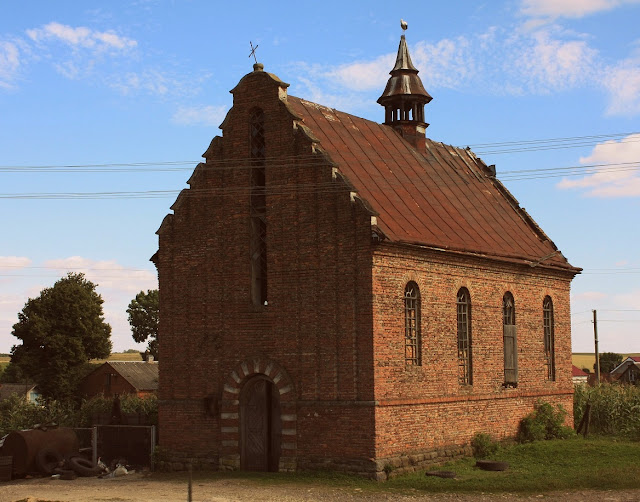
The makeup of the population of Galicia changed drastically after WWII, one reason being the Soviet-Polish population exchanges in the years right after war, during which most of the Poles that lived in Eastern Galicia moved or were deported to the territory of current day Poland. The traces of these Polish communities can be found in the countryside, where abandoned Roman Catholic churches ( kościół  in Polish or  kostel  in Ukrainian) can be found in many villages. Under the Soviets, churches and synagogues were re-purposed, used often as warehouses, stables, museums, etc. While some of the Greek Catholic churches were renovated and today are used by the communities for worship, very few kościółs were resurrected as there are few practicing Roman Catholics in the villages. A  kościół in a  village near Zolochiv St. Maria Magdalena Kościół (built in 1924) in Vovkiv During Soviet times the church served as a mineral fertilizer wareh...

Searching for Traces of the Lipińskis in Oleskiy Region

Image
My great (x5) grandparents Feliks and Tekla Lipiński moved to the village of Koltiv (Kołtów) from Lviv in 1811. Feliks was invited by Count Józef Baworowski to his estate in the countryside to conduct his court orchestra. The former landlords, the Starzeńskis, built a beautiful garden house on a high hill where the court orchestra would often play. Feliks and Tekla's son, the famous violinist and composer Karol Lipiński , often visited them in the village. Nothing of the garden house, the palace, the graves of the noblemen or my relatives, or any other traces of these times remain. Much was destroyed during WWI, and in WWII Koltiv found itself on the front. While Brody is remembered for the "Brody Cauldron" when in 1944 the Red Army encircled Brody and destroyed the German forces, the neighboring region was called the "Koltiv Corridor," due to the fact that the German front in the Koltiv area was shattered by the Soviet army, which broke through a narrow gap i...

Boot Scraper in Koropets

Image
I visited two villages where an ancestor of mine lived/worked. The villages are about an hour from Ivano-Frankivsk and are seperated by the Dniester River. We had to hitch a boat ride from Koropets to the other side of the river and then walk through the village Luha before making it Deleva. Here is a boot scraper located outside the old wooden church (1795) in Koropets. Badeni Palace (1893-1906) in disrepair